Weight Loss in the UAE

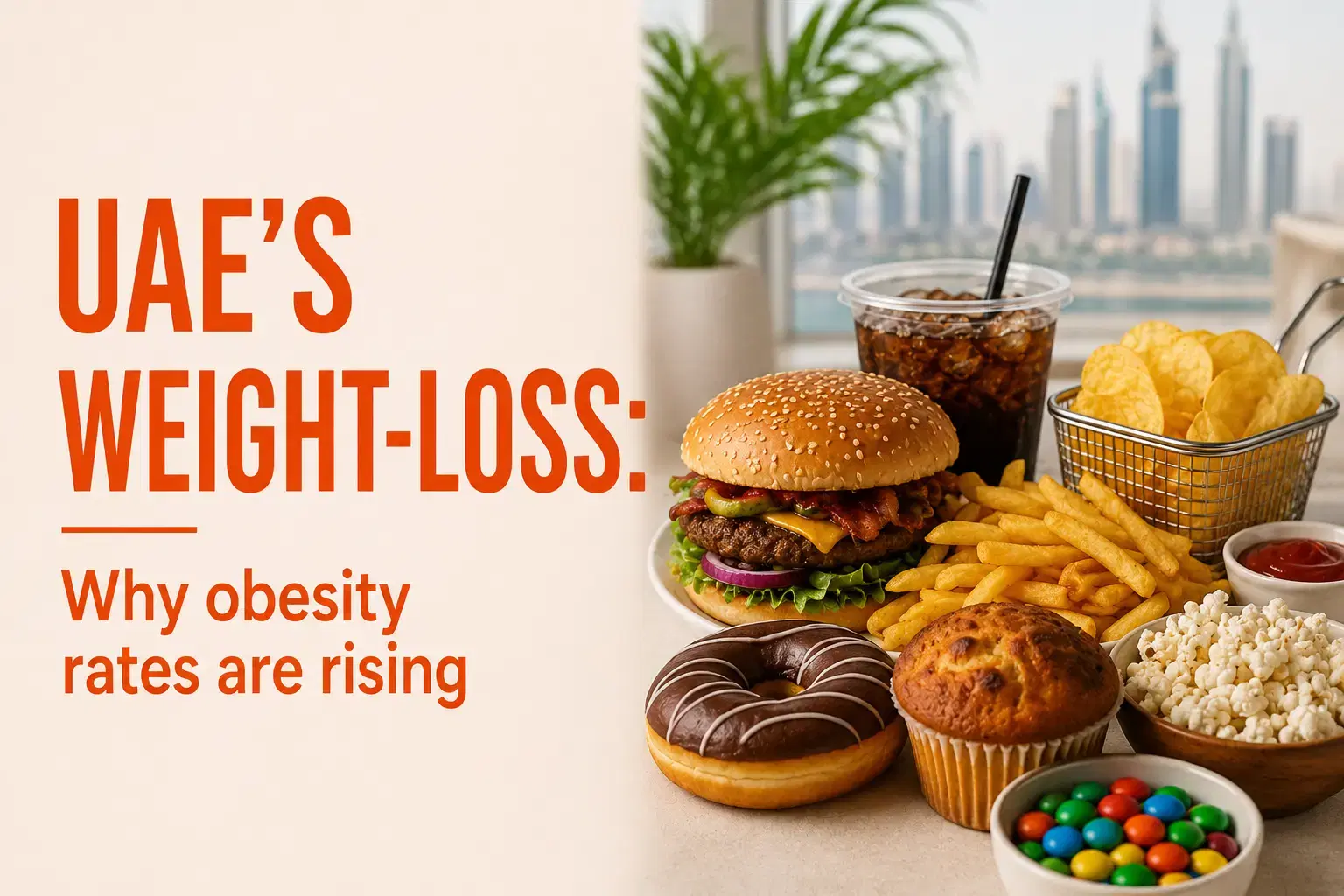
The UAE has a fast-growing weight loss market and a fast-rising obesity rate. This article looks at why both are happening at the same time, what the structural conditions in the UAE actually do to body weight, and why the approach that works here has to be different from the ones that sell well.
The UAE weight loss market is growing fast. So is its obesity rate. Both are happening at the same time, and that's not a contradiction. It's a signal that most of the solutions being sold are aimed at the wrong problem.
The person who has tried two gym memberships, a supplement programme, and a short-cycle detox over the last few years and is still roughly where they started isn't failing for lack of effort or information. They've been buying interventions designed for a market, which is a different thing from being designed for the problem. In the UAE's specific food environment, that gap is wide enough to swallow years of genuine attempts at weight loss
The UAE Doesn't Have an Effort Problem. It Has an Environment Problem.
Data on obesity prevalence across the Gulf region places the UAE among the highest rates in the world, with figures that have risen consistently over two decades. This is happening in one of the wealthiest, most educated, most health-information-saturated populations on the planet. If the problem were a lack of awareness or a shortage of willpower, the numbers would look different. They don't.
A landmark review in The Lancet argued that the global rise in obesity is primarily driven by what researchers call an obesogenic environment: a set of structural conditions that make high-calorie, low-activity behaviour the default rather than the exception. The UAE is a concentrated version of this. Food delivery infrastructure is world-class and operates around the clock. The climate limits outdoor activity meaningfully for a large part of the year. Working hours are long and unpredictable. The car handles almost every journey. Social eating culture in the UAE is built around abundance.
These aren't character flaws. They're conditions. And conditions don't respond to motivation. A disciplined person adapting to the UAE food environment still gains weight if their eating structure isn't deliberately set up to work against those conditions. The weight gain isn't a discipline outcome. It's an adaptation outcome. The environment is extremely good at what it does.
What Most Weight Loss Products Are Actually Built For
Gym memberships, supplement stacks, meal replacement programmes, short detox cycles. These are all built around the same mechanism: raise effort for a defined period. The gym produces results if you go consistently. The supplement works if you use it as directed. The detox delivers while you're doing it. All of them ask the person to sustain elevated effort against the grain of their environment for as long as the product period lasts.
Research tracking weight loss outcomes over multi-year periods found that the probability of an individual achieving and maintaining significant weight loss through conventional interventions is very low across five-year windows. The products produce short-term results. The results don't hold. The market accommodates this outcome: the person who regains weight after a membership lapses is the most likely buyer for the next product. This isn't a design flaw. It's a business model that reflects a problem nobody has bothered to fix.
The gym closes every night. The supplement runs out. The detox ends on day fourteen. The environment that produced the weight gain in the first place doesn't close, run out, or end. It's open at 2am when the delivery app suggests something. It's present in every meeting that runs late and every day too hot to walk anywhere. Effort-based interventions work for as long as the effort holds. In the UAE, the environment almost always outlasts the motivation.
The person who has genuinely tried and is still where they started hasn't failed at weight loss. They've succeeded at every product's defined period and then run out of structure when the product ended. That's a completely different problem from what they were sold a solution to.
What Actually Changes the Outcome Here
The distinction that matters is between interventions that require you to fight your environment every day and ones that change your structural default within it. These are not the same thing, and only one of them works past the first six weeks.
When meals are pre-decided and arrive consistently, the daily decision about what to eat in a demanding city disappears. The friction that exhausts dietary effort in the UAE isn't lack of knowledge or motivation. It's the sheer volume of decisions that accumulate in a full working day before the question of dinner even arrives. Remove those decisions and the environment loses most of its traction. The delivery app notification at 9pm has less pull when dinner has already been handled.
This is what separates people who maintain weight loss in this environment from the ones who cycle through interventions. Not a different level of dedication. A different relationship with the default eating pattern. The environment hasn't been conquered. It's been sidestepped. The structure runs in the background of the actual life being lived, not the ideal version of it that existed during the detox.
The UAE's specific conditions, the hours, the heat, the delivery culture, the social eating calendar, aren't changing. Any weight loss approach that depends on those conditions improving is waiting for something that won't arrive. What actually produces lasting results here is a structure that works inside the real environment, not an effortful campaign against it.
The market sells effort. What works in this environment is structure.
Delicut's Performance Plan is built for the real conditions of living and working in the UAE: consistent weight loss meals that arrive pre-decided, appropriately portioned, and timed to fit a full day without requiring planning, cooking, or food decisions at the end of it. Not a product period with an end date. A structural default that runs in the background of the life you're already living. See the Performance Plan here.
Key Takeaways
UAE obesity rates are rising in a wealthy, educated, health-aware population. This is an environment problem, not a knowledge or effort problem. The structural conditions here make weight gain the default outcome for most eating patterns.
Most weight loss interventions are effort-based in a problem that outlasts effort. Gym memberships, supplements, and detox cycles work while they run. When they end, the environment is still there. The market's repeat-customer model reflects this outcome.
What changes the outcome is changing the structural default, not raising the effort level. Pre-decided meals remove the decision load that the environment exploits. The structure runs when motivation doesn't. That's the difference between a campaign and a result that holds.
FAQs
Q: Is the UAE environment really that different from other places for weight management?
Meaningfully, yes. The combination of round-the-clock food delivery, a climate that limits outdoor activity for months at a time, long working hours, car-dependent infrastructure, and a social eating culture built around large, high-calorie meals is fairly unique in its concentration. Other cities have some of these factors. The UAE has most of them at once, which is part of why obesity rates here are significantly above the global average despite high income and health awareness.
Q: If gym memberships don't work long-term, should I not bother with exercise?
Exercise is genuinely good for health independent of weight. The issue isn't with exercise itself. It's with treating a gym membership as the primary lever for weight management in an environment where diet is the dominant variable. Ninety percent of weight change comes from what and how much is eaten, not from exercise volume. The gym helps. It just can't compensate for an unstructured eating pattern in an environment that makes calorie surplus the easy default.
Q: What does a structural eating approach actually look like day-to-day in Dubai?
It means the food decisions are made once rather than repeatedly across the day. Meals arrive at consistent times, in appropriate portions, without requiring planning, shopping, or cooking after a full schedule. The question of what to eat at any given point is already answered. That's it, mostly. The result isn't a dramatic change in willpower. It's just that the environment's pull toward unplanned, high-calorie convenience loses most of its force when there's already a meal in place.
Trending Searches:
Meal Plan Dubai | High-protein Meal Plan | Meal Plan Ajman | Meal Plan Al In | Meal Plan Sharjah | Meal Plan Subscription
Saja Davood
Nutritionist, Delicut
As a Registered Nutritionist with a degree in Food Nutrition and Dietetics, Saja brings over five years of hands-on experience. She designs personalised, science-backed nutrition plans to help manage conditions such as diabetes, hypertension, obesity, PCOS, and digestive disorders. Her approach centres on Medical Nutrition Therapy (MNT), using food and lifestyle adjustments to prevent and manage chronic diseases in a practical, sustainable way.

Related Blogs

The No Refined Sugar Meal Plan
Oct 9, 2026 | 8
Delicut Introduces New Arabic Dishes to Its Menu
Sep 9, 2026 | 8
1,000 Calories vs 1,500 Calories: What's the right range for your body?
May 27, 2026 | 8
Metabolism Slowdown: The Signs Your Body Shows Before the Scale Does
May 19, 2026 | 8
The Relocation Weight Trap
May 26, 2026 | 8
Meal Plan Results First 30 Days
May 25, 2026 | 8
Weight Loss in the UAE
May 25, 2026 | 8
Structured Meal Planning
May 23, 2026 | 8
Meals for Bloating and Acid Reflux
May 21, 2026 | 8
Influencer Diet Culture: Why the Plan That Worked for Them Won't Work for You
May 21, 2026 | 8