1,000 Calories vs 1,500 Calories: What's the right range for your body?

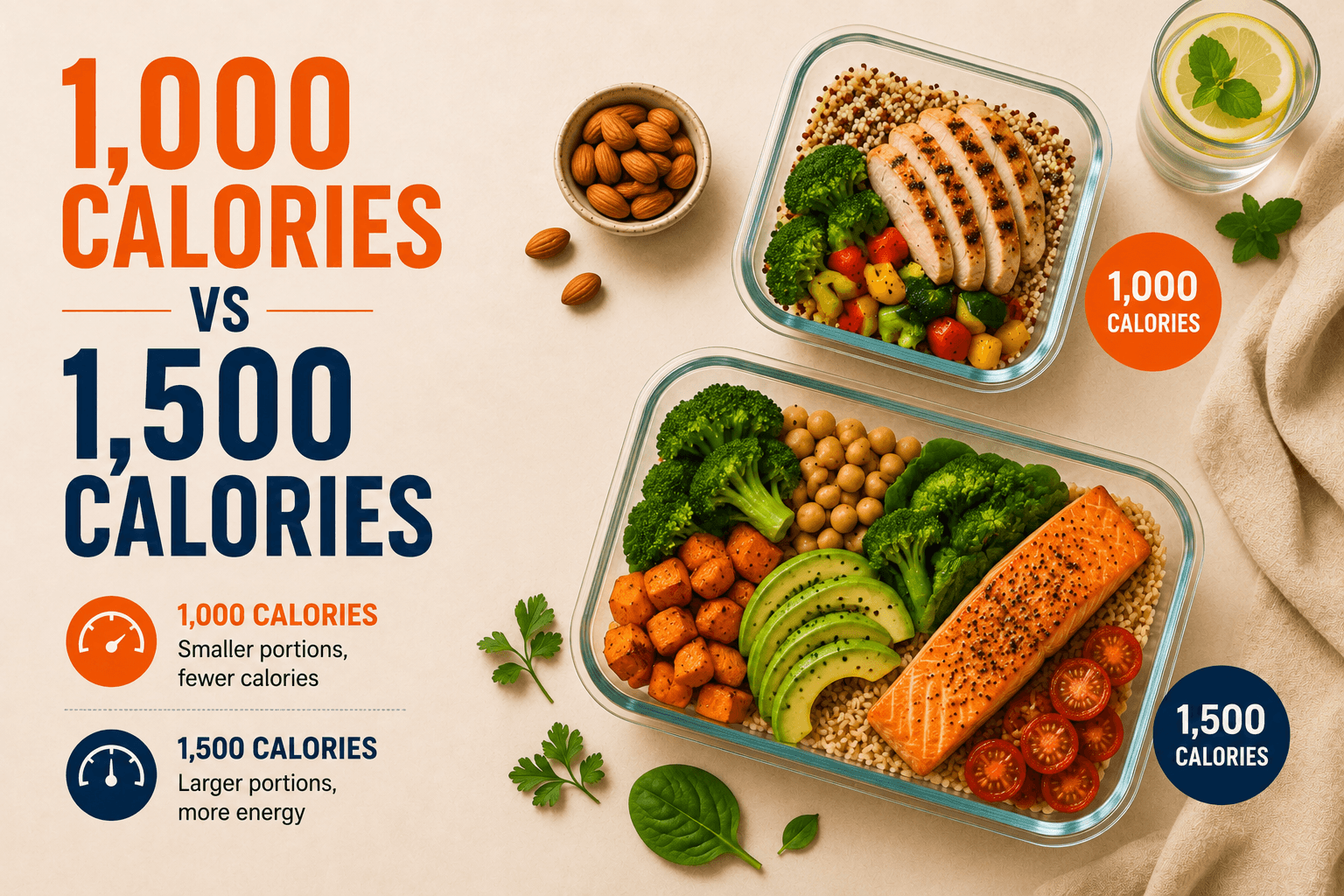
The debate between a 1,000 calorie diet and 1,500 calories assumes one of them is universally right. Neither is. This article explains where calorie needs actually come from, why the same number produces different results in different bodies, and how to think about your own range rather than picking a number from someone else's plan.
The 1,200 calorie figure that shows up in most weight loss advice has a very specific origin. It came from diet research conducted in the 1950s, designed around a particular group of women at a particular activity level. It got cited, simplified, and repeated until it became the number everyone reaches for, not because 1,200 has any special physiological significance but because it got said enough times to feel official.
Neither 1,000 nor 1,500 has a more personal origin than that if you found it in an article. Both are round numbers that arrived in someone else's body first. The question of which one is right for fat loss isn't answered by comparing the two figures. It's answered by knowing what your own body actually needs, and neither of those numbers starts there.
Your Calorie Needs Were Never a Round Number
The body runs on a maintenance level: the amount of energy it needs to hold its current weight given its size, composition, and daily movement. That number is built from specific individual inputs. Height, weight, lean mass, age, and how much the person moves through the day all feed into it.
Validated research on resting metabolic rate calculation established that energy needs are derived from body-specific variables, not from a universal figure. Change any of those inputs and the maintenance level shifts with them. A 5'3", 60kg woman who works at a desk has a completely different maintenance level from a 5'9", 85kg man who is on his feet for most of the day. Both of them picking 1,500 calories from the same article are not doing the same thing to their bodies.
The person who eats 1,400 calories for a month and loses almost nothing isn't failing or cheating. Their maintenance might be 1,600, making 1,400 a very small deficit. The person eating 1,400 and losing steadily might have a maintenance around 2,000, making the same number a real and appropriate cut. Identical number. Completely different physiological reality.
This is the fundamental problem with picking a 1,000 calorie diet or 1,500 calories from a comparison article. Neither figure was calculated for your body. It was calculated for nobody in particular, which means it may be right, too aggressive, or not aggressive enough depending entirely on who's running it.
The Same Number Means Something Different in Every Body
1,500 calories is a meaningful deficit if your maintenance is 2,100. It barely qualifies as a deficit if your maintenance is 1,700. At a maintenance of 1,500, it isn't a deficit at all. It's simply maintenance wearing a diet label.
Research on metabolic responses to calorie restriction found that the body's adaptation to a calorie deficit varies based on the individual's baseline and the degree of restriction relative to that starting point. A 600 calorie deficit in someone whose maintenance is 2,400 produces a different response than the same 600 calorie deficit in someone at 1,800. The absolute number is the same. What it represents physiologically is not.
This is why two people can follow the identical calorie diet and report completely opposite experiences. One loses steadily and feels fine. The other loses slowly, feels fatigued, and gives up convinced the approach doesn't work. The approach might be working perfectly for the first person's body. It may genuinely not be a real deficit for the second person's. Eating the right number of calories for your body starts with knowing what your body's baseline actually is, not guessing from a list of popular options.
The other side of this is also true. A 1,000 calorie intake for someone whose maintenance is 1,400 is an aggressive deficit that's likely to produce muscle loss and metabolic adaptation before meaningful fat loss gets going. The same 1,000 calories for someone at a 2,600 maintenance would be extreme restriction. The number doesn't carry meaning until it's measured against the individual.
How to Actually Find Your Range
The right calorie target for fat loss has two boundaries. It needs to sit below your maintenance by enough to create consistent fat loss, generally somewhere between 300 and 600 calories less than what your body needs to hold its current weight. And it needs to stay high enough that the body isn't producing the muscle loss and metabolic slowdown that come with severe restriction.
For most people this range lands somewhere between 1,200 and 1,900 calories, but not because those are magic numbers. Because that's where most maintenance levels minus an appropriate deficit tend to fall. Someone smaller and less active will be at the lower end. Someone larger, more muscular, or more active will be considerably higher. The range isn't the answer. Your position within it is.
The practical approach is to work backward. Estimate your maintenance based on your actual weight, height, and activity level rather than picking a round number and hoping it fits. Set your target from that reference point. You'll almost certainly land between 1,000 and 1,500 somewhere, but you'll know it's the right number because it was derived from your baseline rather than borrowed from someone else's. A plan built around your specific inputs will produce consistent results where a generic calorie target produces inconsistency, because it's running the numbers that belong to your body, not a rounded approximation of someone else's.
Your calorie target should start with your body, not a round number.
Delicut's Build Your Own Plan configures your meals around your actual calorie and macro requirements, built from your specific inputs rather than a universal calorie diet figure. Not 1,200 because that's what diet articles say. Your number, structured into a plan that runs it correctly for the body you actually have. Start building your plan here.
Key Takeaways
The 1,200 calorie figure has no individual physiological basis. It came from mid-century diet research on a specific population and has been repeated as a universal default ever since. Neither 1,000 nor 1,500 calories was calculated for your body.
The same calorie number means different things in different bodies. 1,500 calories is a real deficit for one person and barely below maintenance for another. The figure only means something relative to that individual's actual maintenance level.
The right range is your maintenance minus an appropriate deficit. For most people this lands somewhere between 1,200 and 1,900 calories, but the specific number is derived from your inputs, not selected from a comparison article.
FAQs
Q: How do I estimate my maintenance calories without a nutritionist?
A rough estimate comes from your body weight in kilograms multiplied by a factor based on activity. Sedentary people are typically in the range of 28 to 32 times bodyweight in kilograms. Moderately active people sit closer to 33 to 37. Very active people still. These are approximations, not precision, but they give you a reference point that's orders of magnitude more useful than picking 1,200 from an article. Set your deficit from that estimate and adjust based on what actually happens over three to four weeks.
Q: Is a 1,000 calorie diet ever the right target?
For some people, yes, in specific circumstances. Someone quite small, older, and sedentary might genuinely have a maintenance in the 1,400 to 1,500 range, making 1,000 calories an aggressive but not extreme cut. For most adults of average size and activity, 1,000 calories is below the threshold where the body starts sacrificing lean mass to meet energy needs, which tends to produce worse fat loss outcomes over time rather than faster ones. The number isn't inherently wrong. It's wrong when it represents an extreme relative to your individual baseline.
Q: I've been eating at 1,200 calories for months and results have stalled. What should I do?
Dropping calories further is rarely the right move at this point. The stall is usually metabolic adaptation from prolonged restriction, which means the body has adjusted its energy expenditure downward to match the intake. The more effective path is to increase protein, add structured movement if it isn't present, and potentially raise calories slightly for a few weeks to let the metabolic rate recover before resuming the deficit. Pushing lower in an already-adapted metabolism produces diminishing returns and typically makes the next attempt harder.
Trending Searches:
Meal Plan Dubai | High-protein Meal Plan | Meal Plan Ajman | Meal Plan Al In | Meal Plan Sharjah | Meal Plan Subscription
Saja Davood
Nutritionist, Delicut
As a Registered Nutritionist with a degree in Food Nutrition and Dietetics, Saja brings over five years of hands-on experience. She designs personalised, science-backed nutrition plans to help manage conditions such as diabetes, hypertension, obesity, PCOS, and digestive disorders. Her approach centres on Medical Nutrition Therapy (MNT), using food and lifestyle adjustments to prevent and manage chronic diseases in a practical, sustainable way.

Related Blogs

The No Refined Sugar Meal Plan
Oct 9, 2026 | 8
Delicut Introduces New Arabic Dishes to Its Menu
Sep 9, 2026 | 8
1,000 Calories vs 1,500 Calories: What's the right range for your body?
May 27, 2026 | 8
Metabolism Slowdown: The Signs Your Body Shows Before the Scale Does
May 19, 2026 | 8
The Relocation Weight Trap
May 26, 2026 | 8
Meal Plan Results First 30 Days
May 25, 2026 | 8
Weight Loss in the UAE
May 25, 2026 | 8
Structured Meal Planning
May 23, 2026 | 8
Meals for Bloating and Acid Reflux
May 21, 2026 | 8
Influencer Diet Culture: Why the Plan That Worked for Them Won't Work for You
May 21, 2026 | 8