OMAD Effects on Muscle

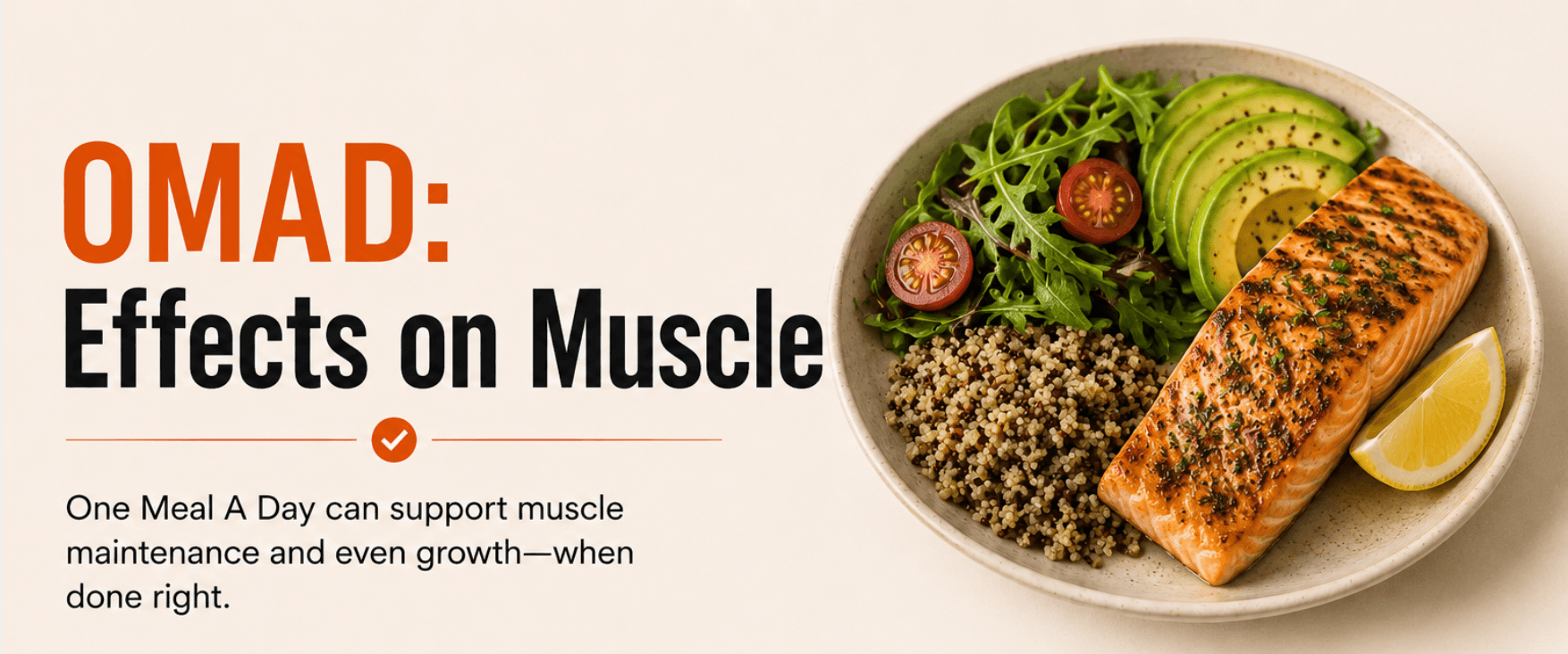
You found a protocol that fits your schedule. One meal, usually post-workout, hitting your macros in one sitting. The deficit is locked in. The training is consistent. But the muscle fullness you had three months ago is quietly disappearing, and the mirror is giving you feedback you did not sign up for.
OMAD effects on body composition are more complicated than the calorie math suggests. The issue is not whether you can hit your protein number in one meal. The issue is what your body actually does with it, and for how long.
Your Protein Number Is Right. Your Timing Is What's Costing You Muscle.
Muscle protein synthesis (MPS) is the biological process that repairs and rebuilds muscle tissue after training. It needs two things: a mechanical stimulus from resistance training and amino acid availability in the bloodstream.
MPS is not a continuous background process. It runs in pulses. Each protein-containing meal elevates MPS for roughly three to five hours. After that window, it returns to baseline regardless of how much protein was consumed in that one sitting. Your muscles do not bank the surplus and extend the anabolic window. They take what they can use in the time available and stop.
Research comparing protein distribution patterns across the same daily total found that dividing intake across multiple meals produced significantly greater MPS than consuming the same quantity in one or two large doses. The timing of amino acid delivery mattered independently of the total amount consumed.
Intended behavior: calculate the daily protein target, hit it in one meal, and trust the number.
Actual behavior: one MPS pulse per day while the remaining 20 to 22 hours are spent in amino acid scarcity.
Why the gap: the number looks correct on paper. What it cannot show is the absence of anabolic signalling for most of the recovery period.
Three to four protein feedings across the day, each triggering an independent MPS pulse, is what the research consistently supports for OMAD muscle retention and growth. One meal cannot replicate that signal regardless of the dose size.
OMAD Compresses What You Can Eat, and That Compression Has a Real Cost
In a training context, caloric restriction needs to be precise. Too deep a deficit and the body starts breaking down muscle alongside fat to meet its energy demands. The cut becomes a compromise on both fronts.
The stomach has a finite capacity per meal. Satiety signals activate well before most people can physically consume everything their training and deficit math requires. On OMAD, this creates an untracked shortfall. Most people end up 300 to 500 calories below their intended target without realising it, because the meal physically couldn't hold any more.
A controlled trial comparing one meal per day against three meals across eight weeks found that the one-meal group lost more lean mass alongside fat, even when caloric intake was theoretically equated between groups. The untracked under-eating built into the single-meal format was part of why.
Intended behavior: use OMAD to eliminate the need for constant tracking, trusting one large meal to auto-regulate.
Actual behavior: natural satiety cutoffs prevent the full calorie target from being reached, creating a deficit that is deeper than planned.
Why the gap: tracking is removed but the physiological limit on stomach capacity is not. The untracked shortfall accumulates daily.
A consistent 300-calorie shortfall becomes a 2100-calorie weekly deficit on top of the intended cut. That is aggressive enough to push the body into using muscle tissue for energy alongside fat. If you are going to run OMAD weight loss in a training context, the one meal needs to be tracked. And once you track it, you often find that eating everything you actually need in one sitting is physically uncomfortable or impossible.
What OMAD Effects Do to Training Recovery Over Time
Recovery from resistance training is not just the 48 hours after a session. It is the cumulative nutritional environment across days and weeks that determines whether the body rebuilds stronger or simply holds on.
Resistance training creates both muscle protein breakdown and synthesis. In a well-fed state, synthesis dominates. In a chronically under-fed or poorly timed state, breakdown accumulates. The net effect over weeks is the difference between gaining, maintaining, or quietly losing muscle.
A large meta-analysis on protein and lean mass outcomes in resistance-trained individuals confirmed that total protein intake and distribution across the day are the two biggest nutritional drivers of muscle outcomes. OMAD's timing problem undermines the distribution requirement, and its satiety ceiling undermines the total intake requirement. Both factors work against the training stimulus simultaneously.
The mistake: early OMAD results, often improved mental clarity and some fat loss, are attributed to the protocol being correct. The actual source of those early wins is the calorie deficit, not the meal timing.
The resolution: structured macro distribution across the day supports the MPS requirement. This does not require constant eating. It requires that protein reaches your muscles at multiple points across the recovery window, not just once.
Your training is doing its job. Your nutrition window is not.
Delicut's Performance Plan is built around the protein distribution and calorie precision that OMAD effects structurally prevent. Macro-tracked, prepared daily, and designed to hit your body composition targets without the muscle retention trade-off. No satiety ceiling. No single-pulse problem. Explore the Performance Plan here.
Key Takeaways
Track your protein timing for three days, not just the total. Most OMAD practitioners find they have one MPS pulse per day where three to four are needed for OMAD muscle retention.
Log your actual calorie intake for one week against your target. Most people eating OMAD are 300 to 500 calories below their planned deficit due to satiety limits, without tracking the shortfall.
If muscle retention matters to your cut, restructure your eating window. Even splitting into two meals eight hours apart generates a second MPS pulse that OMAD does not.
Use the three to five hour post-meal MPS window as your training timing reference. One post-workout dose does not replace the need for multiple daily protein signals.
FAQs
Q: Can I build muscle on OMAD if I hit my daily protein target?
Total protein matters but timing also matters independently. Research shows that distributing the same daily protein across multiple meals produces greater MPS than a single large dose. Hitting the number in one meal means one anabolic pulse per day, which is insufficient for meaningful OMAD body composition gains in a training context.
Q: What if I time my OMAD meal right after training?
Post-workout eating captures one MPS elevation window. The problem is that muscle protein breakdown and synthesis continue well beyond the post-workout period. A single meal, even perfectly timed, only covers one window out of the three to four that matter daily.
Q: How does OMAD compare to 16:8 for muscle retention?
16:8 creates a much smaller window restriction and allows two to three meals within the eating period. That means two to three MPS pulses per day rather than one. For one meal a day muscle retention, 16:8 is significantly more compatible with training goals.
Q: Is OMAD better suited to fat loss than muscle gain?
It is more compatible with fat loss goals if tracked carefully, but even then the lean mass data is not favourable. The Stote et al. trial found that the one-meal group lost more lean mass proportionally than the three-meal group. For any goal that involves preserving or building muscle, the OMAD structure works against you.
Saja Davood
Nutritionist, Delicut
As a Registered Nutritionist with a degree in Food Nutrition and Dietetics, Saja brings over five years of hands-on experience. She designs personalised, science-backed nutrition plans to help manage conditions such as diabetes, hypertension, obesity, PCOS, and digestive disorders. Her approach centres on Medical Nutrition Therapy (MNT), using food and lifestyle adjustments to prevent and manage chronic diseases in a practical, sustainable way.

Related Blogs
1,000 Calories vs 1,500 Calories: What's the right range for your body?
May 27, 2026 | 8
Metabolism Slowdown: The Signs Your Body Shows Before the Scale Does
May 19, 2026 | 8
The Relocation Weight Trap
May 26, 2026 | 8
Meal Plan Results First 30 Days
May 25, 2026 | 8
Weight Loss in the UAE
May 25, 2026 | 8
Structured Meal Planning
May 23, 2026 | 8
Meals for Bloating and Acid Reflux
May 21, 2026 | 8
Influencer Diet Culture: Why the Plan That Worked for Them Won't Work for You
May 21, 2026 | 8
Appetite Suppression: Why Coffee, Cigarettes, and Skipped Meals Make You Hungrier
May 18, 2026 |
Flat Stomach Diet Plan for Less Bloat
May 15, 2026 | 8