The Burnout Diet

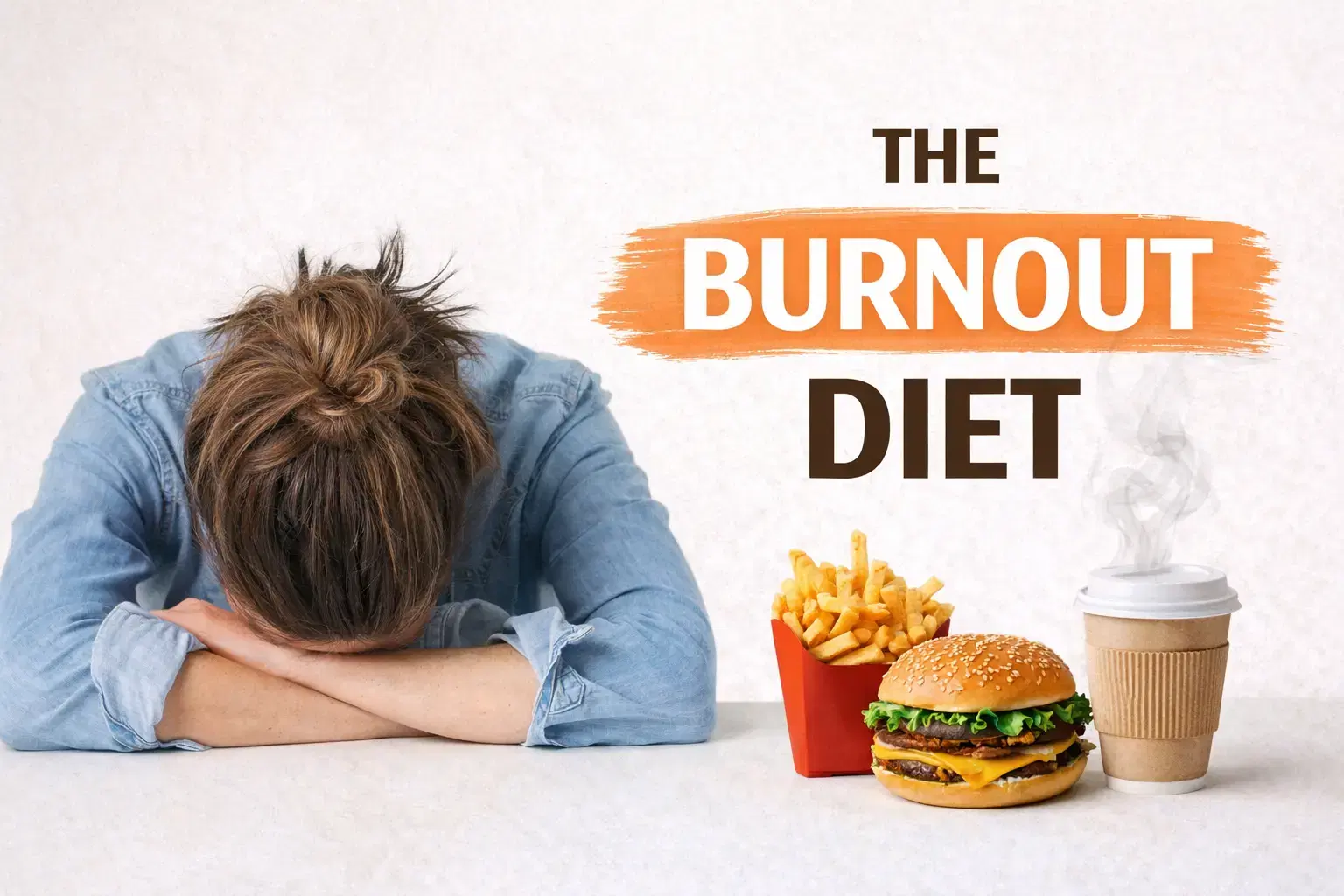
How does stress eating quietly become your default routine?
Most people don’t realise they’re stress eating.
There’s no big moment where you lose control or decide to “eat badly.” Instead, eating habits shift subtly as stress builds. Meals become irregular, food choices become reactive, and eating starts filling emotional or mental gaps, not just physical hunger.
Over time, this pattern becomes normal. People assume it is just part of being busy.
That’s what the burnout diet actually looks like. Not something you choose, but something that forms when stress, fatigue, and too many decisions quietly take over how and why you eat.
How does chronic stress change appetite and eating behaviour?
When stress sticks around, the body starts adapting and that changes how hunger works.
Chronic stress keeps cortisol elevated. Research published on ncbi.nlm.nih.gov shows that prolonged cortisol exposure alters appetite signals, increases preference for energy-dense foods, and makes it harder to feel full
At the same time, stress reduces sensitivity to internal hunger and fullness cues. People become less aware of when they are genuinely hungry and more likely to eat because they’re tired, mentally drained, or just trying to push through the day.
That’s why stress eating often doesn’t feel emotional. It feels practical. Food becomes a way to keep going when everything else feels heavy.
Why does stress eating rarely look like overeating?
Stress eating is usually pictured as overeating or endless snacking. But most of the time it shows inconsistency.
People under constant stress tend to eat very little earlier in the day, then end up compensating later. Multiple studies & research on NCBI links stress with meal/breakfasts skipping, irregular eating patterns, and higher calorie intake in the evening.
That pattern puts pressure on digestion and blood sugar. Energy drops during the day, then spikes late at night. Sleep gets lighter. Appetite feels off the next morning. And the whole thing quietly repeats, without ever feeling like a clear problem.
The cognitive load behind stress driven eating
Stress eating isn’t just about the body. It’s about what’s going on in your head.
When your mental load is high, your brain looks for something easy and familiar to take the edge off. Food does that. It gives a predictable sense of comfort and relief, in dopamine & serotonin responses. This is well documented in behavioural research summarised on ncbi.nlm.nih.gov, which links stress, decision fatigue, and reward-seeking behaviour.
In these moments, food choices stop being thoughtful and start becoming automatic. People reach for what’s familiar and convenient, not because they don’t care, but because they’re mentally spent.
That’s also why stress eating usually shows up later in the day, when patience is low, energy is gone, and decision-making feels like too much effort.
Why does burnout eating often go unnoticed?
One reason burnout eating is so hard to spot is that it doesn’t immediately mess with productivity. People keep working, training, and showing up. From the outside, everything looks fine.
But internally, things start to feel off. Digestion gets unsettled. Sleep isn’t as deep. Energy becomes unpredictable.
Because it happens slowly, most people blame age, workload, or a lack of motivation, not the way stress has quietly reshaped how they eat.
And that’s how the burnout diet keeps going, without ever really being noticed.
Why is willpower an ineffective solution here?
Stress eating is often tackled with more rules and restraint. People try to eat less, cut foods out, or lean harder on discipline to feel back in control.
Research suggests that self-control becomes harder to maintain when your brain is under sustained stress or mental fatigue. Studies on NCBI show that stress can disrupt executive functions, the mental skills that help you stay focused and make deliberate choiceswhich makes relying on willpower less dependable when you’re running low on mental energy.
Research on self-control shows that the mental effort we use to regulate behaviour isn’t infinite. Classic work on the “strength model” of self-control suggests that after sustained cognitive effort or stress, our ability to keep exerting self-control can drop, making reliance on willpower less dependable when you’re mentally worn down.
When stress is high, adding more effort usually backfires. What helps is reducing friction which is why rigid food rules rarely hold up during busy or overwhelming phases, even among highly motivated individuals.
How structured eating breaks the burnout cycle?
Structured eating tackles stress eating at the root, not by trying to suppress it, but by removing the conditions that keep it going.
When meals are regular, balanced, and predictable, the body gets a steady sense of safety. Blood sugar stays more stable, appetite signals settle, and food no longer has to double as a stress regulator.
Research on habit formation and routine, summarised on ncbi.nlm.nih.gov, shows that predictable behaviours reduce cognitive load and emotional reactivity, especially under stress.
Put simply, structure turns reactive eating into automatic nourishment.
Where Delicut fits in burnout aware eating habits?
Burnout recovery doesn’t need perfect nutrition. It needs consistency that doesn’t take effort.
That’s the idea behind Delicut meal plans. Meals are portioned, balanced, and planned ahead, so eating doesn’t require constant decisions, guessing, or “fixing it later.”
When the uncertainty around what to eat, when to eat, and how much to eat is taken out of the picture, a lot of the pressure that drives stress eating starts to ease.
Food goes back to doing what it’s meant to do, nourish you, not carry around the emotional weight.
Saja Davood
Nutritionist, Delicut
As a Registered Nutritionist with a degree in Food Nutrition and Dietetics, Saja brings over five years of hands-on experience. She designs personalised, science-backed nutrition plans to help manage conditions such as diabetes, hypertension, obesity, PCOS, and digestive disorders. Her approach centres on Medical Nutrition Therapy (MNT), using food and lifestyle adjustments to prevent and manage chronic diseases in a practical, sustainable way.

Related Blogs
1,000 Calories vs 1,500 Calories: What's the right range for your body?
May 27, 2026 | 8
Metabolism Slowdown: The Signs Your Body Shows Before the Scale Does
May 19, 2026 | 8
The Relocation Weight Trap
May 26, 2026 | 8
Meal Plan Results First 30 Days
May 25, 2026 | 8
Weight Loss in the UAE
May 25, 2026 | 8
Structured Meal Planning
May 23, 2026 | 8
Meals for Bloating and Acid Reflux
May 21, 2026 | 8
Influencer Diet Culture: Why the Plan That Worked for Them Won't Work for You
May 21, 2026 | 8
Appetite Suppression: Why Coffee, Cigarettes, and Skipped Meals Make You Hungrier
May 18, 2026 |
Flat Stomach Diet Plan for Less Bloat
May 15, 2026 | 8