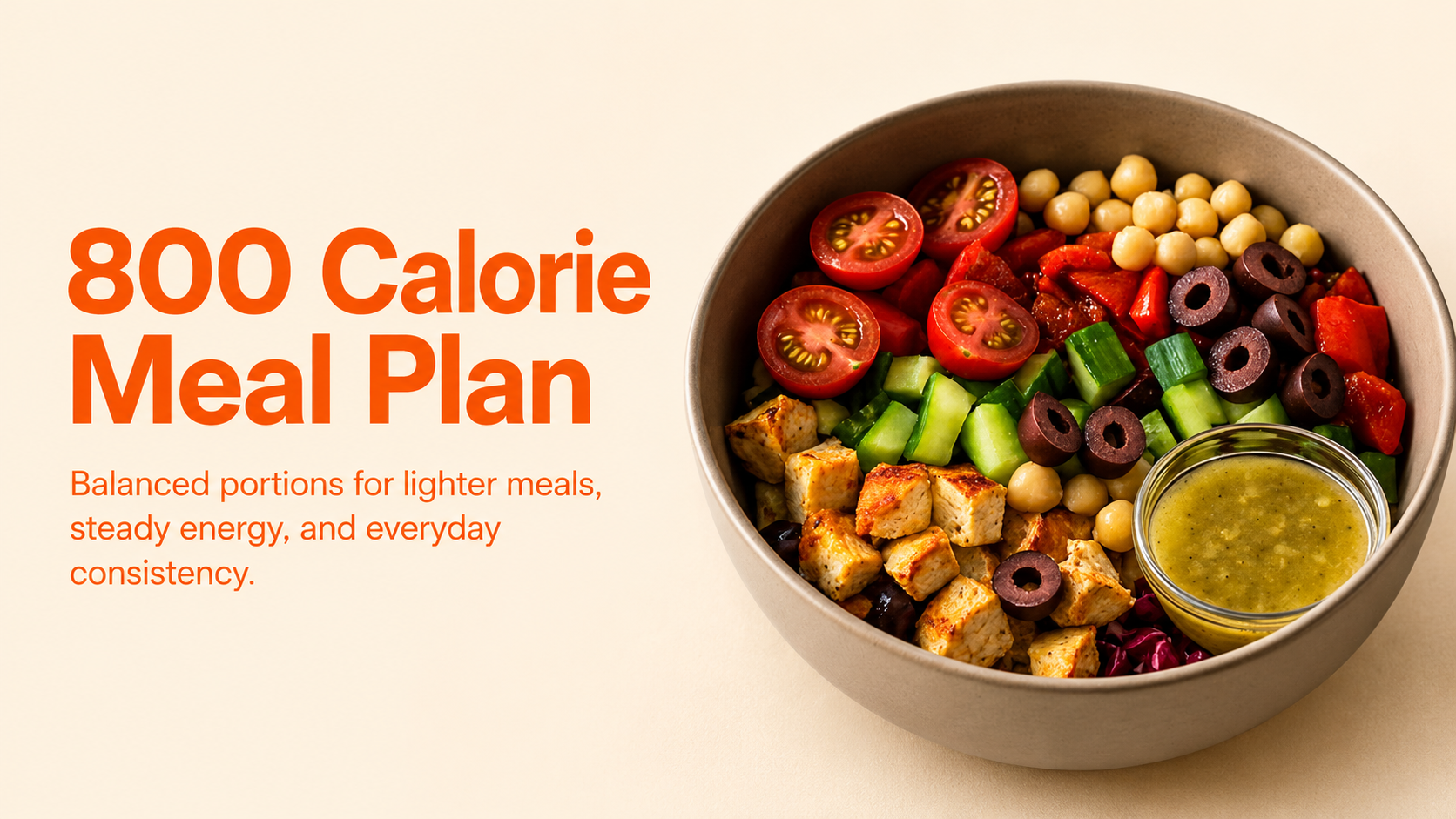

800 Calorie Meal Plan: Risks and Realities You Need to Know
May 8, 2026 | 8 min
There's a version of an 800 calorie meal plan that has clinical backing and a version that carries real, documented risks. This article breaks down the difference, what the research says happens to muscle mass and metabolism on extreme restriction, and what actually works for the same fat loss goal without the downsides.
800 calories a day isn't always dangerous. That's the starting point most articles skip, because nuance is harder to write than a warning.
The clinical literature on Very Low Calorie Diets is real. Outcomes exist. But the version most people actually attempt, cutting to 800 calories on their own with a food tracking app and whatever's in the kitchen, is not the same thing as a supervised medical protocol. The gap between those two approaches is exactly where the risks live.
When 800 Calories a Day Is a Medical Tool
Very Low Calorie Diets have been studied seriously in clinical medicine since the 1970s. In supervised settings, typically for patients managing obesity, type 2 diabetes, or preparing for bariatric surgery, they produce real outcomes. A meta-analysis of VLCD trials shows meaningful short-term weight loss, improved metabolic markers, and in specific populations, remission of type 2 diabetes.
What makes those results possible isn't just the calorie number. It's everything around it. Fortified meal replacements cover micronutrient requirements that whole food at 800 calories can't meet. Regular blood work catches problems before they compound. Medical supervision sets the duration and manages the transition back to normal eating. Remove any of those elements and you're not running a VLCD. You're just eating very little.
Most people who research an 800 calorie meal plan online read about clinical outcomes and then attempt to replicate them at home using regular meals and calorie counting. Same number, completely stripped protocol. That's where it goes wrong.
The Risks That Are Documented, Not Speculated
Muscle loss is the first one and probably the most consequential. At 800 calories without structured protein intake, the body runs short on amino acids and starts converting muscle tissue to meet its energy needs. Lean mass drops faster than fat mass in the early weeks of severe restriction.
Research on 800 calorie diets and lean body mass found that unsupervised very low calorie restriction led to significant reductions in resting metabolic rate alongside lean mass loss. Lose enough muscle and the body burns fewer calories at rest, which means the same 800 calorie diet that produced rapid loss in week one produces almost nothing by week six. The metabolism adapted because the lean mass that drives it was being used as fuel.
Then there's gallstone formation, which fewer people know about but is well-established in the literature. Rapid weight loss, regardless of method, reduces gallbladder motility and increases bile concentration. The faster weight comes off, the higher the risk. Supervised VLCD protocols specifically address this because researchers already worked out it's a real consequence, not a fringe concern.
The micronutrient problem is the third one, and it's structural. 800 calories of whole food simply cannot cover your full micronutrient requirements without fortification. Iron, zinc, B vitamins, omega-3s, all of these get compromised on extended unsupervised restriction. Clinical VLCDs use specialised meal replacements because this problem was identified decades ago. A home version using regular food doesn't have a solution for it.
What the Evidence Actually Supports for the Same Goal
The person researching an 800 calorie plan wants substantial fat loss, probably faster than a conventional approach. That's a fair goal. The research on structured moderate deficits, 400 to 600 calories below maintenance anchored around adequate protein, shows comparable fat loss outcomes over 8 to 12 weeks.
The results look similar on the scale. The internal picture is different. A properly structured moderate deficit holds muscle, keeps metabolic rate stable, avoids the gallstone risk that comes from inadequate fat intake during severe restriction, and doesn't create the micronutrient debt that compounds over weeks of extreme eating.
The body that finishes a well-structured moderate deficit can maintain its results because nothing that determines long-term weight maintenance, muscle mass, metabolic rate, hunger hormones, was damaged getting there. That's what sustainable fat loss means in practice. Not slower. Just not broken at the finish.
Severe restriction produces fast results. Structure produces results that hold.
Delicut's Essentials Plan is built around the dietary pattern that research supports for fat loss without the specific risks of extreme restriction: protein-anchored meals, adequate micronutrient coverage, consistent timing. The goal is the same as an 800 calorie meal plan. The body you end up with is different. See the Essentials Plan here.
Key Takeaways
The risks of an 800 calorie diet come from the conditions, not just the number. Supervised clinical VLCDs work because of the protocol around them. Remove the micronutrient supplementation, monitoring, and exit strategy and you're left with extreme restriction and none of the safeguards.
Muscle loss at 800 calories is fast, and the metabolic consequences last longer than the diet. Resting metabolic rate drops in proportion to lean mass lost, which is why 800 calorie results decelerate sharply after the first few weeks.
A structured moderate deficit produces comparable fat loss outcomes without the documented risks. Same scale result over a slightly longer window, with muscle intact, metabolism undamaged, and no gallstone risk from adequate fat intake.
FAQs
Q: Is an 800 calorie diet ever safe to do without medical supervision?
For most healthy adults, the answer is no, not for more than a very short period. The micronutrient coverage problem alone makes extended unsupervised restriction risky. Short-term supervised protocols exist and have clinical backing. A self-imposed 800 calorie diet using regular food and a calorie app doesn't replicate that and carries the specific risks outlined above.
Q: I've heard the Fast 800 has good evidence behind it. Is that different?
The research on programmes like the Fast 800 is real and the outcomes in supervised or structured settings are meaningful, particularly for type 2 diabetes management. What gets lost in the popularisation is that the original clinical work was done with medical supervision, specific meal replacement protocols, and defined parameters. A DIY version at home using regular food at 800 calories is not the same study.
Q: If I've already been doing 800 calories for a few weeks, what should I do?
Don't drop calories further if results have stalled. That's usually a sign the metabolic adaptation is already underway. The better move is to gradually increase intake while raising protein, which helps rebuild lean mass and stabilise metabolic rate before continuing any deficit. Doing this slowly over two to three weeks before resuming a moderate deficit produces better long-term results than pushing lower.
Saja Davood
Nutritionist, Delicut
As a Registered Nutritionist with a degree in Food Nutrition and Dietetics, Saja brings over five years of hands-on experience. She designs personalised, science-backed nutrition plans to help manage conditions such as diabetes, hypertension, obesity, PCOS, and digestive disorders. Her approach centres on Medical Nutrition Therapy (MNT), using food and lifestyle adjustments to prevent and manage chronic diseases in a practical, sustainable way.
Related Blogs

Breast Cancer Awareness Month

The No Refined Sugar Meal Plan

Delicut Introduces New Arabic Dishes to Its Menu
1,000 Calories vs 1,500 Calories: What's the right range for your body?
Metabolism Slowdown: The Signs Your Body Shows Before the Scale Does
The Relocation Weight Trap
Meal Plan Results First 30 Days

Weight Loss in the UAE
Structured Meal Planning

Meals for Bloating and Acid Reflux
Related Blogs
Breast Cancer Awareness Month
The No Refined Sugar Meal Plan
Delicut Introduces New Arabic Dishes to Its Menu
1,000 Calories vs 1,500 Calories: What's the right range for your body?
Metabolism Slowdown: The Signs Your Body Shows Before the Scale Does
The Relocation Weight Trap
Meal Plan Results First 30 Days
Weight Loss in the UAE
Structured Meal Planning
Meals for Bloating and Acid Reflux