1600 Calorie Meal Plan for Steady Weight Loss

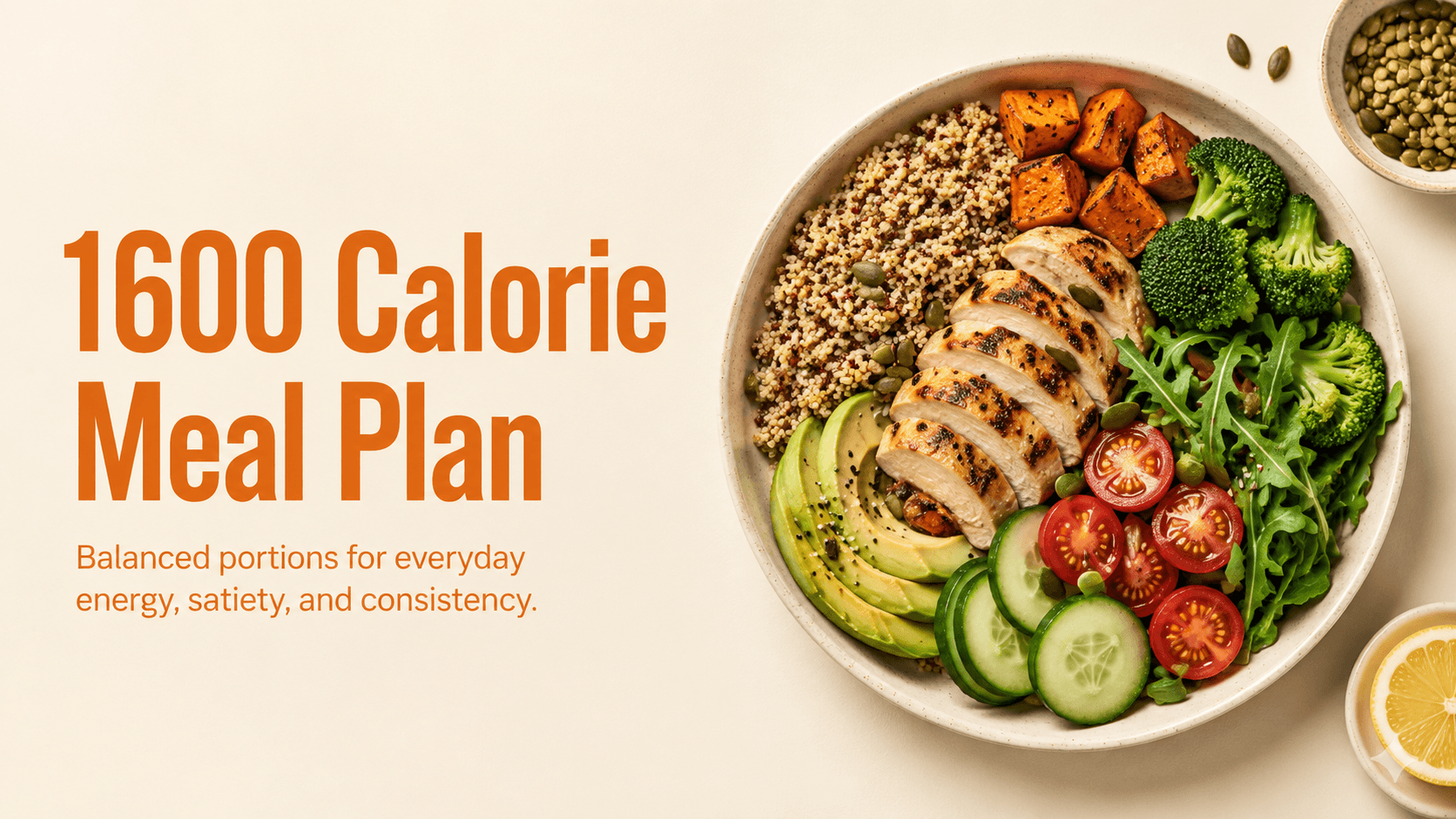
Most 1600 calorie meal plans work for three weeks and then stop. Not because the calorie target is wrong but because the dietary pattern inside it triggers metabolic adaptation. This article explains what that actually means, why protein intake is the variable that determines how much the body adapts, and what a 1600 calorie meal plan built to resist adaptation looks like.
1600 Calorie Meal Plan for Steady Weight Loss: Why It Stalls and How to Fix It
Week one works. Week two, still going. Somewhere around week three or four, the scale just stops. You haven't changed anything. The same foods, the same portions, the same 1600 calories. The most common explanation you'll find is that your body 'got used to it.' That's not wrong, but it's not the whole story either.
Metabolic adaptation is a real, documented response to sustained calorie restriction. Research on adaptive thermogenesis in humans shows the body reduces its energy expenditure in response to a deficit, and it does this through several mechanisms that are entirely invisible to someone tracking a 1600 calorie meal plan. What most people don't know is that how much the body adapts is partly determined by what those 1600 calories look like. The number isn't the only variable.
What Adaptive Thermogenesis Is and Why It Happens on Schedule
The body doesn't experience a calorie deficit as a fat loss event. It experiences it as a resource shortage and responds by becoming more efficient. Resting metabolic rate drops. The thermic effect of food decreases. Non-exercise activity thermogenesis, the unconscious movement like fidgeting, standing, general restlessness, also falls. Individually each of these is small. Combined, they can close a 300 to 400 calorie deficit to near zero.
This isn't the body 'fighting back.' It's a predictable physiological response to sustained energy restriction. Studies on metabolic adaptation and weight loss show that adaptation begins early and accelerates as lean mass is lost. That last part is the key. The degree of metabolic adaptation is directly tied to how much muscle is lost during the diet. Lose more muscle, adapt more. Hold the muscle, the adaptation is far smaller.
Which means the question isn't just how many calories you're eating. It's whether the way you're eating them is protecting the muscle that keeps your metabolism running.
Most 1600 Calorie Diets Don't Have Enough Protein to Stop This
The thermic effect of protein is higher than any other macronutrient. The body burns roughly 20 to 30% of protein calories just processing them, compared to 5 to 10% for carbs and 0 to 3% for fat. A 1600 calorie diet built around 55% carbohydrates and 90 grams of protein has a meaningfully lower effective calorie burn than the same 1600 calories structured around 150 grams of protein. The number looks the same. The metabolic cost is different.
Protein also preserves lean muscle during a deficit. Every pound of muscle lost is roughly 6 calories fewer burned at rest per day, which doesn't sound like much until it compounds across weeks of dieting. Most standard 1600 calorie meal plans online are carb-heavy and protein-light. They hit the target. They don't protect the tissue that determines how long the target keeps working.
This is why the same diet stops working at week four. Not because the body is broken. Because muscle was quietly being used as a fuel source the whole time, and the metabolic rate adjusted accordingly.
What a 1600 Calorie Meal Plan That Resists Adaptation Looks Like
Protein at every meal, anchoring each eating occasion. The total matters but the distribution matters more. 40 grams at breakfast, 40 at lunch, 40 at dinner, with protein-led snacks in between gives the body a consistent signal that muscle protein synthesis is worth maintaining. Front-load the protein earlier in the day especially, since morning meals set the hormonal tone for muscle retention through the rest of it.
Carbohydrates timed around activity, not spread randomly. The body uses carbs most efficiently when insulin sensitivity is higher, which is during and after training. Shifting the bulk of carbs to those windows keeps blood sugar more stable, supports performance, and means less of those carbs get stored rather than burned.
The total stays at 1600. The structure prevents the adaptation loop. Muscle is preserved, thermic effect stays higher, NEAT doesn't collapse. That's what steady weight loss at this intake level actually requires: not a lower number, just a smarter pattern inside the same one.
1600 calories is enough. What you do with them is everything.
Delicut's Performance Plan structures your 1600 calorie meal plan around protein distribution and macro timing, not just hitting a daily number. Meals designed to preserve muscle through a deficit, keep metabolic rate stable, and produce steady weight loss that doesn't stall at week four. See the Performance Plan here.
Key Takeaways
Metabolic adaptation at week three or four isn't bad luck. It's a predictable response to sustained calorie restriction, and how much it happens is determined by how much muscle you lose during the diet.
Protein is the variable that controls both muscle retention and metabolic rate during a 1600 calorie diet. A carb-heavy plan at the same calorie total triggers more adaptation. A protein-anchored plan triggers far less.
The fix isn't eating less. It's restructuring the same 1600 calorie meal plan around protein distribution and carb timing so the body has no reason to adapt aggressively.
FAQs
Q: Should I drop below 1600 calories when the plateau hits?
Usually not, and often counterproductive. Dropping calories further when the plateau is caused by metabolic adaptation just accelerates the adaptation. The body responds to a bigger deficit by becoming more efficient again. Fixing the protein distribution and meal structure inside 1600 calories first gives you a better answer before cutting more.
Q: How much protein do I actually need at 1600 calories to prevent muscle loss?
A target of 1.6 to 2.2 grams per kilogram of bodyweight covers most people in a calorie deficit. At 1600 calories that's usually somewhere between 130 and 160 grams depending on your size. Distribute it: 35 to 45 grams at each main meal rather than hitting the total mostly at dinner. The distribution matters as much as the number.
Q: What if I've already been on 1600 calories for six weeks and I've lost muscle? Is it too late?
No. Reintroducing adequate protein and rebuilding the meal structure stops further muscle loss quickly. Muscle can be rebuilt over time even while remaining in a deficit, especially with resistance training alongside the diet adjustment. The adaptation isn't permanent. The body responds to what you give it now, not what you gave it six weeks ago.
Saja Davood
Nutritionist, Delicut
As a Registered Nutritionist with a degree in Food Nutrition and Dietetics, Saja brings over five years of hands-on experience. She designs personalised, science-backed nutrition plans to help manage conditions such as diabetes, hypertension, obesity, PCOS, and digestive disorders. Her approach centres on Medical Nutrition Therapy (MNT), using food and lifestyle adjustments to prevent and manage chronic diseases in a practical, sustainable way.

Related Blogs
1700 Calorie Meal Plan for Fat Loss
May 13, 2026 | 8
Pescatarian Diet Plan for Balanced Eating
May 11, 2026 | 8
800 Calorie Meal Plan: Risks and Realities You Need to Know
May 8, 2026 | 8
1600 Calorie Meal Plan for Steady Weight Loss
May 7, 2026 | 8
1800 Calorie Meal Plan for Fat Loss: Why the Number Isn't the Whole Story
May 5, 2026 |
Diet Plan to Lose Belly Fat Naturally: What Clean Eating Gets Wrong
May 4, 2026 | 8
7-Day Gestational Diabetes Meal Plan: The Structure That Actually Stabilises Blood Sugar
May 11, 2026 | 8
Late Night Cravings in Dubai
Apr 30, 2026 | 8
Meal Prep Myth: Why Most People Can't Stick to It
Apr 28, 2026 | 8
Detox Diet Plan: Do You Really Need One?
Apr 27, 2026 |