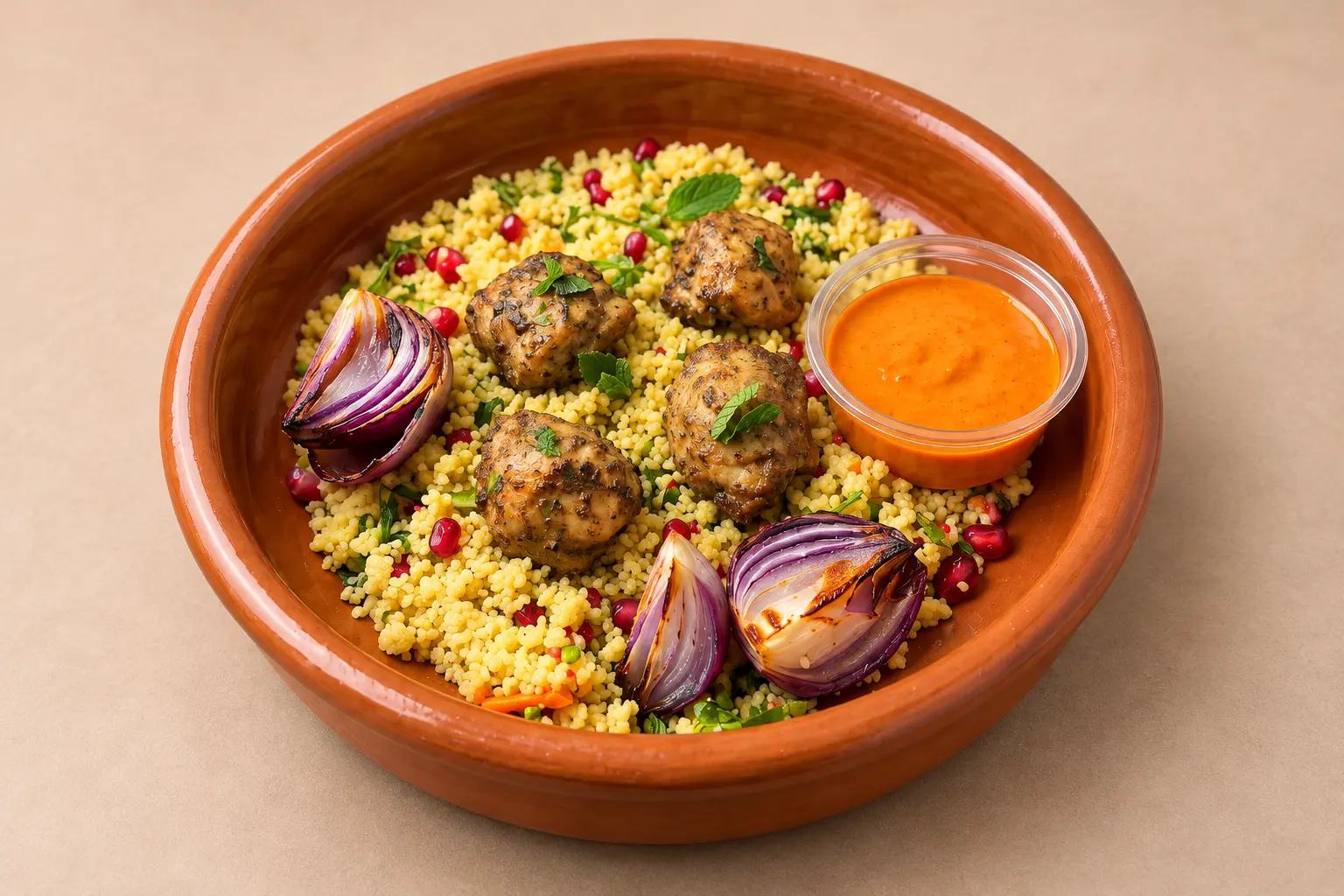

Meal Prep Fatigue Is Real
Nov 16, 2026 | 8 min
By day four, the chicken breast in the fridge tastes exactly the same as it did on Sunday. It is not worse. It just stopped being food.
If you've felt this, you already know it from inside the experience. The usual verdict is that it's a motivation problem, not wanting it badly enough, losing interest in healthy eating. That's not the mechanism. This is a specific, documented biological response to repetition, and it hits hardest in people who are genuinely trying.
And the standard advice for fixing it, more variety, mix it up, makes the whole thing worse. That's what this is about.
What meal prep fatigue actually is (and why it's not in your head)
Sensory-specific satiety is the term for it. Your brain doesn't rate food as a category, it rates individual foods on their own pleasantness scale, and updates those scores continuously. Eat the same thing enough times in a row, and that food's score drops. Everything else you haven't been eating holds steady.
Which is how you end up hungry and uninterested in the container at the same time. These aren't contradictory. They're separate systems. Hunger is the fuel gauge. The palatability system is tracking whether this specific food seems worth eating right now, and by Wednesday it's already filed the chicken breast under 'not right now.'
A British Food Journal study tracked this over 15 days[1], by the end, pleasantness scores for repeated foods had fallen significantly, while foods not eaten during the study held their ratings. The brain evolved to push variety, to prevent the nutritional gaps that come from eating identically forever. It did not evolve to cooperate with Sunday meal prep.
Meal prep goes in the opposite direction. It locks in one food profile across a full week, right at the moment habituation is running fastest.
By Thursday, nothing about the chicken breast has changed. The palatability score has. And the shawarma place two floors down, untouched since Sunday, is running at full appetite-triggering capacity.
Most people read that as a willpower gap. It isn't. The American Journal of Clinical Nutrition followed people enrolled in a structured eating program, people who had specifically signed up to eat consistently[2]. Same habituation effect. Same declining interest in the food they'd committed to. The sign-up was genuine. The biology ran its program anyway.
There are two layers to this problem (Most people only fix one)
The palatability side is one problem. Meal prep fatigue has another layer, and it's quieter.
Call it planning fatigue.
A weekly prep routine involves more decisions than it looks like. What to make. How much of each. Which ingredients are running low. What to do with last week's rice. Whether this week is different enough from last week to actually eat through. Each one is small. By Sunday evening it adds up to more than it looks.
A 2025 review in Nutrients went through how decision fatigue plays out in real-world food contexts[4]. When cognitive load hits its ceiling, people default to whatever needs the least effort. That's the Tuesday delivery order. Not because the food ran out, because working out what to do with the remaining prep crossed a line.
Rotate the proteins, keep the same prep structure, and the palatability side improves, but the Sunday overhead stays identical. That's the ceiling most people hit. One problem solved, the other still running.
What actually fixes it handles both at once: a rotation structured enough that Sunday becomes filling in a template, not making decisions from scratch.
Why "just add more variety" makes it worse
The standard response to meal prep boredom is to add more variety. More proteins on the roster, more recipes, more things in the fridge on Sunday.
Short-term: works. Medium-term: creates a different problem.
24 studies on variety and meal intake, pooled in a systematic review in the American Journal of Clinical Nutrition[3], converged on a consistent finding: more variety means more total eating. Not because people become less disciplined. Each distinct food gets its own appetite reset, so a rotation with 10 different foods is basically running 10 fresh appetites simultaneously. That's why a buffet operates differently from a dinner plate.
The planning overhead gets worse at the same time. Six different things each Sunday means more time, more food waste when the rotation doesn't land evenly across the week, and a system that collapses the first time life actually gets busy.
Three proteins is usually enough. Two bases. One flavour profile per week. That's the floor, just enough variation to prevent habituation without overcomplicating Sunday.
The 3-2-1 rotation is built on that floor.
|
The 3-2-1 rotation: 3 protein options across the week — chicken, fish, eggs, legumes, whatever fits the plan 2 base carbs — rice and sweet potato, or rice and oats for different meals 1 flavour profile per week — a spice blend, sauce, or herb combination that rotates month to month |
Chicken on rice with a lemon-herb dressing doesn't generate the same sensory experience as salmon on sweet potato with that dressing. Which reads differently to the palatability system than lentils on rice, different enough that the scores stay workable across the week. The specific foods change. The Sunday decisions don't, it's just filling in the template.
WHO guidance on healthy eating calls for variety across food groups[6]. The 3-2-1 structure covers that, it just doesn't require six different preps every Sunday to get there.
What genuinely consistent eating actually looks like
There's a version of eating consistently that holds up over time. Most people who've burnt out on meal prep weren't running that version.
112 people, a weight-loss program, tracked across time by Health Psychology in 2026[5]. The more routineised eating patterns outperformed, 5.9% body weight loss compared to 4.3% in participants with less consistent patterns. The researchers' explanation: routine eating reduced the cognitive overhead around food. The plan was just easier to actually follow.
What those patterns had in common wasn't eating the same meal forever. It was holding the structure constant, macros, timing, framework, while changing what filled the specific slots. That's routine eating. What most people mean by 'eating the same thing' is forced monotony: identical meals, unchanged, until the palatability system files its objection and the whole thing collapses.
Most people who've burnt out were running forced monotony without knowing there was a distinction. Nobody explicitly told them that prepping identical meals every single week was the wrong target. The goal is a stable framework. The specific foods are supposed to rotate inside it.
Breakfast is where most people already get this right. Same protein, same rough calorie range, slightly different fruit or toppings. Nobody burns out on breakfast.
Dinner is usually the opposite, no fixed framework, decisions made daily, and genuinely exhausting by Wednesday. The 3-2-1 rotation applies the breakfast logic to the rest of the day.
For when you want the system handled
If the problem is the system, you can fix the system using the 3-2-1 structure, or you can remove it entirely. Essentials by Delicut is two chef-prepared meals a day, delivered in Dubai, with the rotation and macros already figured out.
You don't plan the rotation. You don't count anything. The food shows up.
Plans from AED 22 per meal.
Key Takeaways
Being hungry doesn't mean you want what you prepped.
The hunger system and the palatability system are separate. When the second one has downgraded a food, forcing through it costs effort in a way that simply not eating wouldn't, which is a strange but real experience, and it's not in your head.
Three protein sources across a week is usually enough.
You don't need a new meal every day to prevent habituation. You need enough rotation that the pleasantness rating resets before it bottoms out. That threshold is lower than people assume, which means the system can be simpler than most people are building it.
Structure and variety aren't a tradeoff.
The plans that hold up keep the framework stable and rotate within it. The ones that collapse treat the specific foods as the structure. When you switch that around, the whole thing becomes easier to run and the palatability system stops generating the signal that makes you quit.
Frequently Asked Questions
How long does it take for meal prep fatigue to set in?
Depends on frequency. If you're eating something twice a day, the palatability score can start declining within a few days, sometimes sooner. Less frequent meals take longer. The more reliable signal isn't the number of times you've had it. It's whether you're still looking forward to it. When anticipating a meal starts feeling neutral rather than actually appealing, the habituation is already running. The score's already been filed.
Is meal prep boredom the same as not liking the food?
Different things, and the difference matters for how you respond. Sensory-specific satiety acts on foods you actively enjoy, not just ones you're tolerating. The same chicken breast that worked in week one genuinely does register differently by week four. Same calories, same protein, different palatability rating. If something you used to enjoy now feels like nothing, that's habituation. Not a changed preference. The preference is still there. The score is temporarily depressed.
Can you push through meal prep fatigue with willpower?
You can muscle through it short-term. The palatability system will just keep filing its objection until something gives. And every forced meal draws from the same cognitive budget that decision fatigue already depleted, so the effort compounds. The more sustainable move is to design the rotation so the signal doesn't fire in the first place. Reserve willpower for things that actually need it.
Does eating varied meals mean you cannot track macros consistently?
No conflict. The numbers are determined by portions and food categories, not which specific protein or carb you used this week. Three different proteins on a rotating schedule still land in the same macro range if the portions are consistent. A structured rotation like 3-2-1 handles this automatically. The variety is in the specifics. The framework stays the same.
Meal prep fatigue isn't a character flaw.
It's a predictable outcome of a design that doesn't account for how the palatability system actually works. If Sunday planning has started feeling like a burden, and the prepped food reliably isn't making it past Tuesday, Essentials by Delicut handles both problems. Two meals a day, delivered in Dubai, with the rotation and macros already figured out. Start from AED 22 per meal.
Citations
[1] Hetherington, M. M., Bell, A., & Rolls, B. J. (2000). "Effects of repeat consumption on pleasantness, preference and intake." British Food Journal, 102(7), 507–521. doi.org/10.1108/00070700010336517
[2] Epstein, L. H., Carr, K. A., Cavanaugh, M. D., Paluch, R. A., & Bouton, M. E. (2011). "Long-term habituation to food in obese and nonobese women." American Journal of Clinical Nutrition, 94(2), 371–376. doi.org/10.3945/ajcn.110.009035
[3] Embling, R. et al. (2021). "Effect of food variety on intake of a meal: a systematic review and meta-analysis." American Journal of Clinical Nutrition, 113(3), 716–741. doi.org/10.1093/ajcn/nqaa352
[4] Brasington, N., Beckett, E. L., Pristijono, P., & Akanbi, T. O. (2025). "The Effect of Decision Fatigue on Food Choices: A Narrative Review." Nutrients, 17(24), 3901. doi.org/10.3390/nu17243901
[5] Hagerman, C. J. et al. (2026). "Do routinized eating behaviors support weight loss?" Health Psychology. doi.org/10.1037/hea0001591
[6] World Health Organization. "Healthy diet." WHO Initiative: Be Healthy. who.int/initiatives/behealthy/healthy-diet
Saja Davood
Nutritionist, Delicut
As a Registered Nutritionist with a degree in Food Nutrition and Dietetics, Saja brings over five years of hands-on experience. She designs personalised, science-backed nutrition plans to help manage conditions such as diabetes, hypertension, obesity, PCOS, and digestive disorders. Her approach centres on Medical Nutrition Therapy (MNT), using food and lifestyle adjustments to prevent and manage chronic diseases in a practical, sustainable way.
Related Blogs
Meal Prep Fatigue Is Real
How much does healthy eating actually cost in Dubai?

Arabic Chicken Dishes: 5 Cooking Traditions
Arabian Dishes Names: A Guide to Delicut's Arabic Food Menu
Popular Arabic Rice Dishes: From Kabsa to Majboos

Breast Cancer Awareness Month

The No Refined Sugar Meal Plan
Delicut Introduces New Arabic Dishes to Its Menu
1,000 Calories vs 1,500 Calories: What's the right range for your body?
Metabolism Slowdown: The Signs Your Body Shows Before the Scale Does
Related Blogs
Meal Prep Fatigue Is Real
How much does healthy eating actually cost in Dubai?
Arabic Chicken Dishes: 5 Cooking Traditions
Arabian Dishes Names: A Guide to Delicut's Arabic Food Menu
Popular Arabic Rice Dishes: From Kabsa to Majboos
Breast Cancer Awareness Month
The No Refined Sugar Meal Plan
Delicut Introduces New Arabic Dishes to Its Menu
1,000 Calories vs 1,500 Calories: What's the right range for your body?
Metabolism Slowdown: The Signs Your Body Shows Before the Scale Does